
If you asked me who my top three game creators were, I’d tell you (in no particular order) Tetsuya Mizuguchi, Shinji Mikami, and Hideo Kojima. Ever since I could remember, I have appreciated and loved the work of these three. The worlds, the stories, and most importantly the experiences these creators have made in gaming, to me, are unforgettable. When Humanity was announced back in 2019, I knew I had to get my hands on it.
I was first introduced to Tetsuya Mizuguchi’s work in the seventh grade by my dear friend John. John was the guy in our friend group who always introduced us to new and unique music (Shinichi Osawa’s SO2 is still one of the best albums of all time), and seemed to have the oddest video games to recommend. There was one, in particular, he just would not stop talking about titled Rez. We’d make fun of him for liking things with “music and shapes” but he insisted we didn’t know what we were talking about.

When I got my first PlayStation 2 later that year, John let me borrow his copy of Rez. It didn’t take very long for me to finally understand what John was ranting and raving about. The music and audio were mind-blowing and reacted to your actions. It was different, fresh, and special.
A few years later Lumines: Puzzle Fusion was released, and then Every Extend Extra (which if you have not played, it is a wild ride). I was hooked. I apologized to John and to this day still feel like I owe him a million more. You can only imagine the shock and excitement we both felt when Child of Eden was announced (an amazing game; I’d do anything for a PC or PS5 port of this).
Humanity is Enhance’s newest title following 2018’s Tetris Effect. I highly recommend it for fans of Mizuguchi’s past titles, and those who have never picked one up. There are both similarities and differences in comparison, and I feel just about anyone can enjoy it. You know the drill: We’re going to break this review down into four categories: story, graphics, sound and music, and gameplay.

Story
If you’ve played Rez or Child of Eden, you are familiar with Mizuguchi’s stories. They touch on large concepts with deep meaning while leaving a lot to the imagination and doors open for interpretation. Rez was about information corrupting cyberspace, and its AI core (Eden) began to doubt its purpose. The player takes on the role of a hacker who is fighting off the viruses that are infecting the firewalls, hoping to reach Eden and save them. Child of Eden, being Rez’s spiritual successor, takes on a similar theme, and Humanity felt like it was telling the other side of those stories: the human side.
While Mizuguchi had input and influence on the story, web designer Yugo Nakamura is the main writer and creator of the concept for Humanity. Nakamura wanted to explore “how we humans and our society would look to an outside form of intelligence, and how they would simulate human group behavior.” One of the main programmers at Nakamura’s company, THA (pronounced one letter at a time), showed an early version of the game to Unity developers at an event where Mizuguchi was a judge. After the event, Mizuguchi reached out to Nakamura, they joined forces, and the rest is history.
Humanity starts with the player waking up as a dog (specifically a Shiba Inu), having no recollection of anything, really. Just that they one day woke up as a dog. They’re in an unfamiliar place and hear a voice in their head. You’re thrown into the first prologue level teaching you the basic mechanics of the game, and then have five more tutorial levels before you really dive into Humanity.

After finishing the prologue, you’re in a large empty area with a defined center. In the center are the people you saved, or as the story says, “the people you led into the light.” You ask the mysterious voice where you are, and it explains you’re in a place called the testing grounds. The testing grounds are a place where trials, overseen by you, will be run on the people.
The voice introduces itself as the Blue Core. It explains that it is one of the first you will encounter, and the trials it will give you are to awaken the people and lead them to the light. A statue then rises from the ground, with the word “AWAKENING,” and how many trials and Goldys have been completed and unlocked. Goldys are like people in the sense you need to lead them to the light, but they play a bigger role in the gameplay (more on that later).
I don’t want to spoil anything, but I do want to say I truly enjoyed the single-player story experience. It gave me a bit of nostalgia from Rez and Child of Eden while simultaneously feeling like a new experience. Each set of trials you unlock is different from the last, and the mechanics introduced are relevant to the story. The seamless integration of mechanics and story really stuck out to me, and add a lot of depth to the story itself.

Graphics
If you were expecting the usual mind-blowing visuals with colors you didn’t think existed exploding in front of you in ways you didn’t think possible, Humanity isn’t that. Unlike previous titles, graphics are not the focus here. In fact, if the game did have insane mind-blowing graphics, I think it would take away from the experience as a whole. I’m not saying the graphics are disappointing, or I didn’t like them. What I am saying is that they were appropriate for the execution.
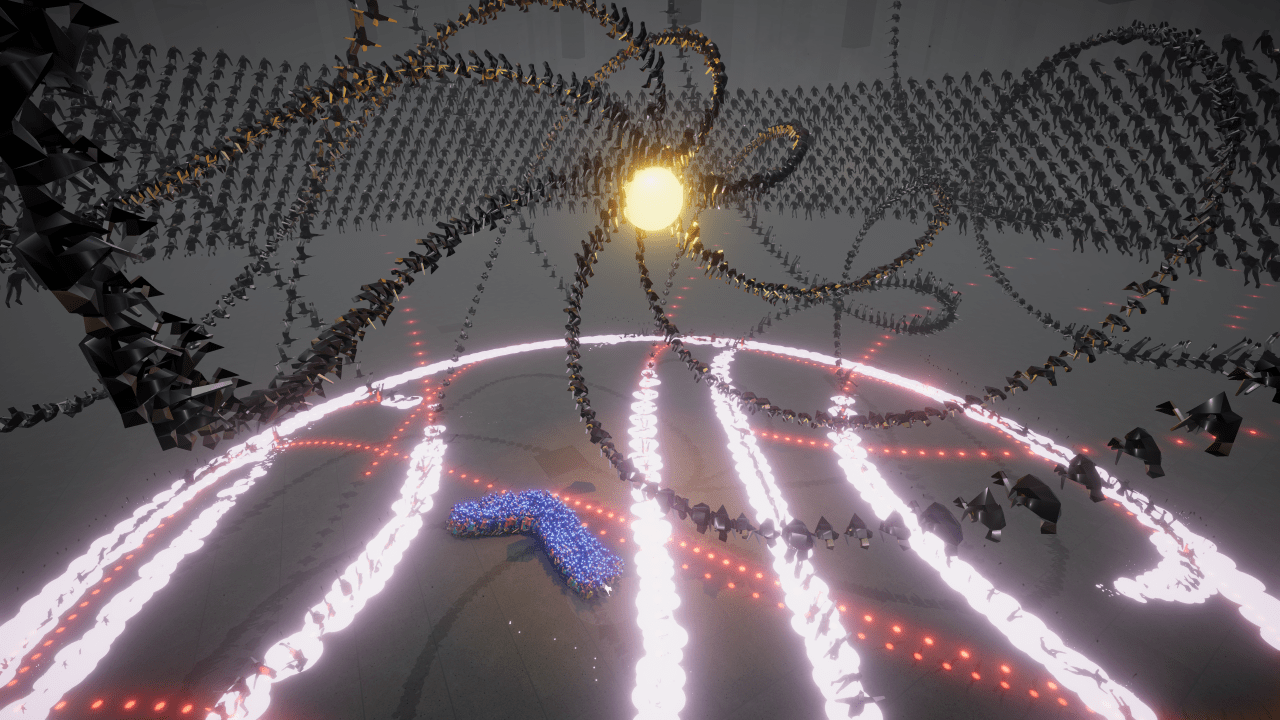
The best way I can explain the way the people look is an HD version of your park-goers in Roller Coaster Tycoon. Simplified people with just enough detail to differentiate from one another. Different skin tones, sizes (implying it’s both adults and children), and genders. So it looks really cool when you have this infinite flow of thousands and thousands of people going through obstacles and into the light.
As you play the game and collect Goldys, you can unlock different models/outfits and skins for the people. The models range from things like suits and looks from the 70s to monoliths, pronouns (him/her/they), and robots. The skins are an additional layer to that, with options like neon, metallic, and cartoon (neon is my personal favorite). The last model I had unlocked was teddy bears; the game asks if you want to apply it when you unlock it, and I unintentionally made the final cutscene very amusing.
The lobby/home screen is probably one of my favorite parts of the game graphically. In the center are all of the people you have led into the light, as well as the Goldys you collected. As you progress in the story, the placement of the humans collected (and Goldys) continues to change and evolve. Each set of trials erects a new silver statue, and as you collect Goldys, they start to fill up with a bronze color. So without looking at the text on the ground, you can closely estimate how many Goldys you have left in that set by looking at the statue. As of writing, I have not gotten all the Goldys in a single set of trials (I’m looking at you, Air Flow), so I am unsure if the statues change color (if they do, my guess would be gold) when they’re all collected.

Sound and Music
Rez, Lumines, Child of Eden, and Tetris Effect have (in my personal opinion) some of the greatest soundtracks in gaming. They are great to listen to and revisit, and even better when you’re replaying these titles due to their reactionary elements. I’ve listened to them in so many places; in the car, on planes, at a friend’s house, and even when I needed a good pick-me-up. I pretty much grew up with both Rez and Child of Eden’s soundtracks. I have so many memories associated with so many of those songs.
Because of Humanity’s nature, the soundtrack doesn’t have the same reactionary elements. If it did, it’d probably be incredibly overwhelming. Much like the graphics, while the soundtrack may not seem like the strongest in the Mizuguchiverse (yes, I just made that up), it’s fitting and appropriate. I’d even say if the soundtrack was similar to the past ones, again due to the game’s nature, it’d probably be unpleasant.
Humanity’s soundtrack is something I would classify as ambient electronic. And while each stage doesn’t have a unique track, the tracks assigned to each stage are very fitting. Once you collect enough Goldys, you unlock the ability to change the track on most stages. You can do this by selecting the track using L1 and R1 on the trials’ title screen, and if you’re someone who doesn’t really want any music at all, there is a track titled “Void.”
If the soundtrack is your main motivator for picking up the game, don’t let this steer you away. As a big Nine Inch Nails fan, I think I speak for myself and many others when I say while The Fragile is my favorite album, the almost entirely instrumental Ghosts albums are just as great for their own reasons.

Gameplay
I went through a roller coaster of emotions while playing through story mode. When figuring out a trial, there’s a real sense of urgency and even sorrow (especially as you watch tens of thousands of people fall into the abyss because you get yourself stuck in a funky position). There’s even this larger feeling of empathy, particularly in the story’s third set of trials.
One of the biggest things I appreciated about Humanity is that its difficulty levels vary, and it’s not a consistent rise, either. Some are most definitely harder than others, but even this may not be consistent from player to player. Because of the level design variations, it’s almost like you’re using different parts of your brain to solve them. If you find yourself really frustrated and want to progress, each level does offer a solution video.
The solution videos definitely come in handy. I was stumped a couple of times and these helped me clear the trials. They do not, however, explain how to get any optional Goldys. You’re on your own for that one! It’s also interesting to watch them after you’ve cleared a trial. There was one trial in particular that had me thinking, “There has got to be a better way to do this. No way did it have to be this convoluted.” Watching the solution video after the fact had me burying my face in my hands. But it also got me excited because that meant there wasn’t just one static way to solve the trials.
If you found a specific trial harder than the others, leave a comment! I’d love to see if the answers are consistent, and how they vary if they’re not.

The title screen for each trial tells you what to expect in terms of what mechanics will be used. In the first handful of trails, in addition, to turn, you unlock jump and high jump. Sometimes you’ll have a lot of mechanics to implement, and sometimes just a couple. This keeps the experience fun and original.
The best way to describe Goldys would be to simply say they are Humanity’s currency. The story explains them as a kind of higher being that the humans worship with every fiber of their being. In most situations, Goldys are completely optional, but eventually, you do run into stages where that isn’t the case. Some stages require at least one Goldy to progress to the next level, but will always offer more than what is required.
If you’re someone that loves a good challenge, I implore you to collect all of them (or at least as many as you can). A trial may seem straightforward, but when you add obtaining Goldys into the mix, it provides a good challenge. If you aren’t able to get them and want to progress, you can always come back to them later, adding replay value to the story mode.
Where I truly believe the game will really shine is its user-created stages. Even now prior to release, there were a handful of user-created stages available for play. Some were from the beta, developers, and other reviewers. The game offers categories (most popular, easy, beautiful sights, etc) and difficulties for each stage, which is calculated by its clear rate.
Humanity is cross-platform between PlayStation and PC (Steam). If you are on PlayStation and don’t want to include the PC user-created stages, you can select that in settings. In addition to being cross-platform, it is a PS4/PS5 cross-buy on PlayStation. Please note that you cannot transfer story mode and stage creator data from PS4 to PS5 and vice versa. And while I, unfortunately, did not play Humanity in VR, VR support is not available for stage creator.
At launch, you’ll be able to upload a maximum of 20 stages total, with a cap of three within a 24-hour period (the developers have noted this number is likely to increase as time goes on). Locally, you can store 50 stages on PlayStation 4, and up to 100 on PlayStation 5 and Steam.
Not only does this game provide a lot of replay value with its user-created stages, its minimum and recommended PC specs open the door for a lot of users to join in.

| Recommended Specs Requires a 64-bit processor and OSOS: Windows 10Processor: Intel i5-4590 (required for VR)Memory: 8GB RAMGraphics: NVIDIA GTX1070 or equivalent (required for VR)Direct X: Version 11Storage: 8GB available space VR support: Quest 2, Rift S, Index | Recommended Specs Requires a 64-bit processor and OSOS: Windows 10Processor: Intel i5-4590 (required for VR)Memory: 8GB RAMGraphics: NVIDIA GTX1070 or equivalent (required for VR)Direct X: Version 11Storage: 8GB available space VR support: Quest 2, Rift S, Index |
At just $29.99, Humanity is a great value. If you have PlayStation Plus Extra or Premium, it will be available for free and be a part of the PlayStation Plus Game Catalog. If you’re a fan of Mizuguchi’s past works, like puzzle games, or just want to try something new and different, I cannot recommend Humanity enough. Every player will get something different out of it, and that’s what makes it truly special.
Humanity was reviewed on PlayStation 5 with a review code provided by Enhance.
Discover more from The Koalition
Subscribe to get the latest posts sent to your email.
